
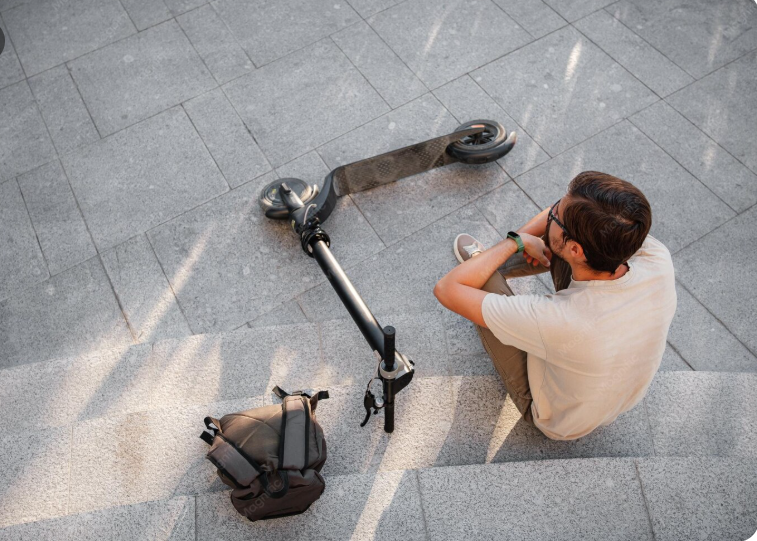
Range anxiety affects 40% of new electric scooter riders within their first year. The gap between manufacturer claims and real-world performance creates this psychological barrier. Understanding battery drain factors, calculating actual range needs, and adopting targeted riding strategies transforms range anxiety into a manageable variable. This guide reveals the mechanics behind battery depletion and provides actionable methods to extend your scooter’s usable range.
The Range Estimation Gap: Lab Tests vs. Pavement Reality
Manufacturers test their scooters in a lab, a perfectly flat, windless, climate-controlled bubble that has zero in common with a typical ride through an American or Australian city. Urban commuters see average ranges hitting 30 miles in real tests versus advertised 40 miles, a 25% variance that reflects the difference between controlled conditions and actual street use.
The single biggest factor dictating your range is the total weight the scooter carries—you, your backpack, your laptop—because the heavier the load, the more motor power needed, especially when accelerating or heading uphill, pulling significantly more juice from the battery. A rider weighing 210 lbs will always get less mileage than a 145 lbs rider on the exact same scooter.
How Weather and Terrain Compress Your Battery Life
Uphill terrain significantly increases energy consumption and reduces range; rapid acceleration, high speeds, and sudden braking drain battery faster; and cold weather, wind, and rain decrease battery efficiency. Cold temperatures below 50 degrees Fahrenheit reduce available capacity by 10-20%. Headwinds create aerodynamic drag forcing your motor to work harder, while a 5% grade incline can reduce range by 15-20%.
Riding Style as Your Primary Range Control Variable
How you ride is the single biggest factor affecting your range; aggressive starts dump huge surges of electricity from the battery. Steady cruising is more efficient than rides full of sudden speed changes; smooth highway-style speed uses far less energy than stop-and-go city traffic, and the same principle applies to your scooter’s battery. Regenerative braking recovers 10-15% of energy on descents, but only with gradual coasting. Smooth acceleration and anticipatory braking are the highest-impact riding adjustments.
The 40-50% Range Buffer Strategy: Your Insurance Policy Against Anxiety
Add a 40-50% buffer to your daily round-trip distance as your best defense against battery aging, surprise detours, hilly terrain, and heavy loads. This is mathematically sound risk management. Here’s the calculation framework:
Scenario | Daily Commute | Buffer Applied | Minimum Scooter Range Needed |
Short urban commute | 10 miles | 40% | 14 miles |
Medium mixed route | 15 miles | 45% | 22 miles |
Long commute with hills | 20 miles | 50% | 30 miles |
Variable weekend use | 25 miles | 50% | 37.5 miles |
All batteries degrade over time; extra range today ensures enough capacity for your commute in a couple of years. This buffer accommodates unexpected route changes, weather deterioration, and the natural 2-3% annual capacity loss in lithium-ion batteries.
Calculating Your Actual Daily Range Requirement
Start with your round-trip distance in miles. Add 10% for route inefficiencies. Multiply by 1.4 or 1.5 depending on terrain and climate. Cold regions or hilly terrain use 1.5; flat, temperate areas use 1.4. Example: 12-mile commute + 1.2 miles inefficiency = 13.2 miles × 1.45 = 19.1 miles minimum range. Verify real-world range claims through independent reviews and user forums, not manufacturer specifications.
Battery Aging and Capacity Retention Over Time
Extend lithium-ion battery lifespan by avoiding deep discharges; avoid leaving the scooter at 0% charge for extended periods; use the “Optimize charging” feature to maximize battery life. Charge to 80% for daily use rather than 100%; this reduces stress on battery chemistry and extends cycle life by 15-25%.
Batteries lose 2-3% capacity annually. A scooter with 40-mile advertised range delivers approximately 38.8 miles after one year and 37.6 miles after two years. Your 40-50% buffer accounts for this degradation.
Operational Tactics: Charging Habits and Route Planning
Before starting your journey, check the scooter’s battery level; for longer rides, pre-plan your route, marking charging stations along the way. Dynamic range indicators adjust remaining distance based on current conditions and are more reliable than static gauges.
Charging frequency matters more than charging speed. Daily top-ups to 80% create less stress than weekly full charges. If your commute is 10 miles with a 25-mile range scooter, charge every other day rather than waiting below 20%.
Pre-Ride Checklist and Real-Time Monitoring
Establish a three-point pre-ride routine: Check battery percentage and remaining range estimate; Verify tire pressure (underinflated tires increase rolling resistance by 5-10%); Review your route for elevation changes and headwind exposure.
Always check your battery percentage before taking off; keep an eye on your TrueRange indicator; unlike traditional fuel gauges, dynamic systems recalculate remaining distance based on your riding style and current mode. If your scooter lacks dynamic range calculation, manually reduce displayed range by 20-25%.
Eco Mode and Power Management During Rides
Eco mode restricts power output to maximize battery life; use it when anxious about remaining range. Eco mode reduces motor power by 30-40%, extending range by 15-25% at the cost of slower acceleration. Activate it when battery drops below 30% or during unexpected headwinds.
Maintain manufacturer-recommended PSI (typically 30-32 PSI for most scooters). Underinflated tires drain 5-10% more battery per mile. Check pressure weekly before longer commutes. Center weight over the deck rather than hanging it from handlebars.
Selecting the Right Scooter: Range Specifications That Actually Matter
Ignore advertised range and focus on three measurable specifications: battery capacity (watt-hours), motor efficiency (watts), and independent real-world range tests. Brushless hub motors in long range scooters deliver 90% efficiency, minimizing energy loss for maximum electric scooter battery life. A 500W motor with 90% efficiency converts 450W into actual propulsion; one with 75% efficiency wastes 125W as heat.
Battery Capacity | Typical Advertised Range | Real-World Range (Flat) | Real-World Range (Mixed Terrain) |
36V 10Ah (360Wh) | 20-25 miles | 15-18 miles | 12-15 miles |
48V 12Ah (576Wh) | 30-40 miles | 22-28 miles | 18-24 miles |
52V 20Ah (1040Wh) | 50-70 miles | 35-45 miles | 28-38 miles |
60V 25Ah (1500Wh) | 80-100 miles | 55-70 miles | 45-60 miles |
Real-World Testing and Independent Range Verification
Manufacturer claims follow unrealistic test protocols: flat terrain, 165-lb rider, no wind, 50-degree temperature. Seek independent reviews from YouTube channels and forums testing under mixed conditions. When comparing models, prioritize reviews specifying test conditions: terrain, rider weight, temperature, and actual distance. A scooter tested at 40 miles on flat terrain by a 150-lb rider will deliver 25-30 miles for a 200-lb rider in mixed urban terrain with the RUGD 153 specifications for efficient energy management.
Frequently Asked Questions
Cold temperatures reduce lithium-ion battery efficiency by 10-20% because chemical reactions slow at lower temperatures, and your motor works harder against denser air and potentially wet roads.
A 210-lb rider will experience 15-25% less range than a 145-lb rider on the same scooter because the motor must work harder to accelerate and maintain speed against increased mass.
Regenerative braking recovers 10-15% of energy on descents and during coasting, making it worthwhile for hilly terrain but less impactful in flat urban environments.
Charge to 80% daily rather than 100%, avoid letting the battery drop below 20%, and maintain moderate temperatures; this extends battery lifespan by 15-25% compared to full-charge cycles.
Yes, a 40-50% range buffer protects against battery aging, unexpected detours, weather changes, and riding style variations. Explore three-WHEELERS and two-WHEELERS options with the AXEL PRO technology for enhanced stability and range management, transforming range anxiety into confidence.