
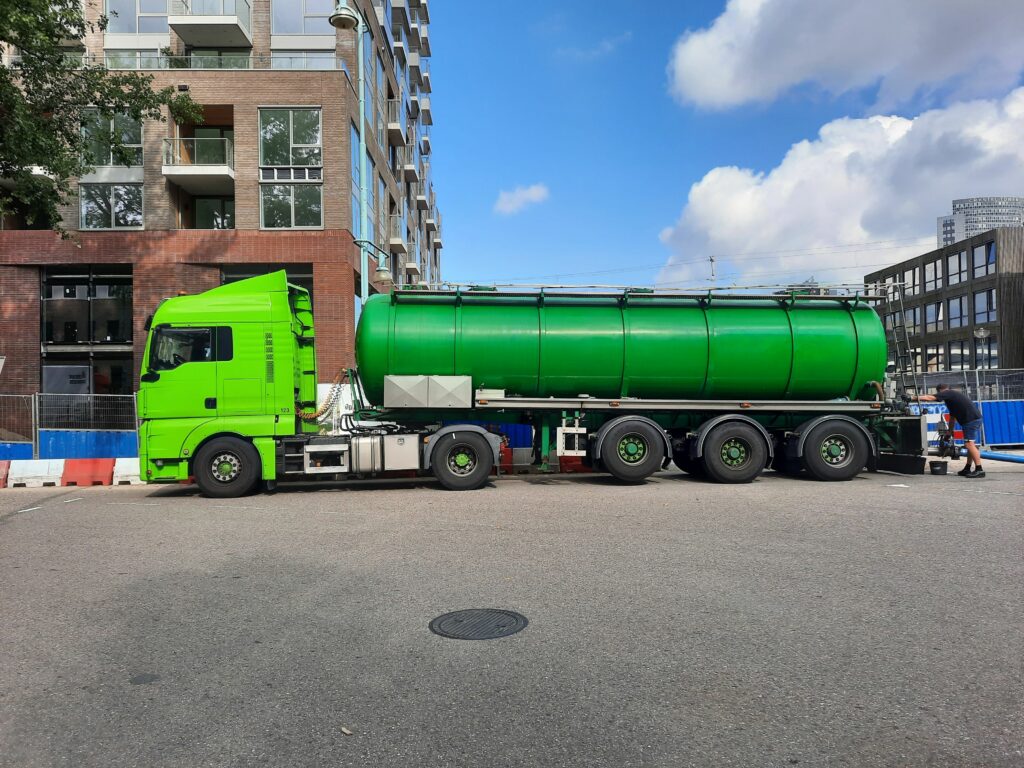
Water distribution in India operates at enormous scale. Municipal corporations, gram panchayats, housing societies, construction sites, and commercial water suppliers collectively move billions of litres of water daily across Indian cities and towns using tanker vehicles. Most of these vehicles run on diesel or petrol. The cost of that fuel is borne either by public budgets or commercial operators, and in both cases, it represents a significant and recurring expense that electric propulsion can reduce substantially.
The water tanker electric vehicle India market is a specialised segment, not a mainstream consumer category. This guide is written for institutional and commercial buyers who are evaluating electrification of water distribution operations with a focus on financial performance, operational reliability, and procurement process.
How a Water Tanker Electric Vehicle Works: The Basics for Non-Technical Buyers
Before evaluating specifications, understand the basic operational structure of an electric water tanker vehicle.
The vehicle has two separate systems:
Propulsion system: The electric motor, battery pack, controller, and drivetrain that moves the vehicle from point A to point B. This is what makes it an electric vehicle.
Water distribution system: The tank, pump, piping, and dispensing equipment that stores and distributes water. This system may be powered electrically from the vehicle’s main battery, from a separate auxiliary battery, or from an independent power source depending on the vehicle design.
These two systems operate somewhat independently. The range of the vehicle is determined primarily by the propulsion battery. The pump operation is an additional energy draw that must be factored into the total energy budget for each route.
Important implication: A vehicle quoted with a 100 km range in standard conditions may deliver 75 to 85 km of range when the pump is operated multiple times per route. Confirm range calculations with the pump system operating when evaluating water tanker electric vehicles.
Applications: Who Uses Electric Water Tanker Vehicles in India
Municipal corporations and urban local bodies: Urban water supply supplementation in areas not served by pipeline. Emergency water distribution during supply disruptions. Bulk water transfer between distribution points. Municipal buyers are typically institutional procurement processes with tender requirements.
Gram panchayats and rural bodies: Water distribution in villages and rural settlements without reliable pipeline supply. Short-route, predictable daily operations that match well with the range and charging profile of electric vehicles.
Housing societies and real estate developers: Tanker supply to residential complexes during construction phase or in areas with inadequate municipal supply. Commercial buyer with cost-consciousness and reliable home-charging infrastructure at the depot.
Construction and infrastructure sites: Dust suppression, concrete mixing water supply, and worker water provision at construction sites. Often short-range, high-frequency use that benefits from easy on-site charging.
Commercial water distributors: Private businesses supplying potable or non-potable water to residential, commercial, and industrial customers on a paid delivery basis. These buyers evaluate on operating cost per trip and vehicle reliability most directly.
The Ekotejas three-wheeler product range includes the WTR 120 water tanker configuration specifically designed for this application category in the Indian market.
Key Specifications to Evaluate for Water Tanker Electric Vehicles
When evaluating any electric water tanker vehicle in India, the following specifications directly affect operational performance:
Tank capacity (litres): Three-wheeler electric water tankers in India typically range from 500 litres to 1,200 litres capacity. Larger tanks increase the weight of the loaded vehicle and reduce range proportionally. Match tank capacity to your actual per-trip distribution requirement rather than maximising tank size.
Loaded range: This is the critical specification. The vehicle must complete its daily distribution route on a full or partial charge. Calculate your total daily route distance, add 20% as a buffer, and use this as the minimum loaded range requirement.
Pump motor power and operation: The pump system is powered from the vehicle’s electrical system. Confirm the pump motor power rating (typically 0.5 to 1.5 kW for three-wheeler tankers) and the estimated energy consumption per dispensing cycle. This allows you to calculate total daily energy consumption including both propulsion and pump operation.
Ground clearance and chassis strength: Water tankers operate on varied terrain including unpaved village roads, construction site approaches, and urban potholed streets. A minimum ground clearance of 180 mm and a high-tensile steel chassis are baseline requirements for mixed-terrain water distribution use.
Charging time: Municipal and commercial operators typically have defined fleet dispatch times. Confirm that overnight charging on available infrastructure fully charges the vehicle within the available window between the end of one shift and the start of the next.
Corrosion protection: Water contact with the vehicle frame, pump components, and electrical connections accelerates corrosion. Confirm the level of corrosion protection treatment applied to the chassis, pump housing, and electrical connection points.
Operating Cost Advantage: Diesel vs Electric for Water Tanker Operations
For a water tanker three-wheeler covering 60 km per day on a fixed distribution route:
Diesel equivalent (10 km/l at Rs. 95/l): Daily fuel: 6 litres Daily fuel cost: Rs. 570 Monthly cost (26 working days): Rs. 14,820 Annual cost: Rs. 1,77,840
Electric equivalent (10 km per kWh including pump, at Rs. 8/kWh): Daily energy: 6 kWh Daily electricity cost: Rs. 48 Monthly cost: Rs. 1,248 Annual cost: Rs. 14,976
Annual operating cost saving: approximately Rs. 1,62,864 per vehicle
For a municipality or panchayat operating five water tanker vehicles, this represents over Rs. 8 lakh per year in reduced operating expenditure, available for reallocation to other public services.
For commercial water distributors, this saving directly improves profit margin on each delivery, improving the financial viability of water distribution as a business.
Procurement Considerations for Institutional Buyers
Municipal corporations and government bodies typically procure vehicles through formal tender processes. For electric water tanker vehicle procurement, the following specifications should be included in tender documents:
- Vehicle type approval certification (ARAI or iCAT)
- AIS 156 compliance for battery pack
- Minimum loaded range at specified tank capacity
- Battery warranty period and conditions
- After-sales service network coverage in the operating district
- Spare parts availability and maximum lead time commitment
- Compliance with CMVR requirements for commercial goods vehicle registration
- Manufacturer’s minimum production and delivery capacity
For commercial buyers, the same specifications apply but the procurement process is simpler. Focus evaluation on after-sales reliability and total cost of ownership alongside purchase price.
The Ekotejas Axle Pro and the broader Ekotejas commercial lineup reflect the brand’s engineering focus on durability and reliability for sustained Indian-condition operation, which applies equally to the water tanker configuration.
What Actually Determines Electric Scooter Price in India?
The sticker price and the on-road price are two different numbers. Here is what makes up the final cost:
Ex-showroom price is the base price before taxes and registration. This is what most brand websites and ads display.
On-road price includes:
- GST at 5% for electric vehicles (compared to 28% for petrol two-wheelers)
- Road tax (varies by state, typically 0% to 6% for EVs)
- Registration charges
- Insurance (first year, mandatory)
- Dealer handling charges
In states like Delhi, Gujarat, and Maharashtra, additional state EV subsidies can reduce the on-road price by Rs. 5,000 to Rs. 15,000. Always ask the dealer for the on-road price specific to your RTO location before comparing models.
The GST advantage alone makes EVs significantly cheaper to register than petrol scooters at the same ex-showroom price.
Price Segments: What Do You Get at Each Level?
Understanding what changes as the price goes up helps you decide where your money is best spent.
Under Rs. 50,000 (On-Road)
This segment typically includes:
- Lead-acid or entry-level lithium-ion battery
- Hub motor between 250W and 750W
- Real-world range of 60 to 80 km per charge
- Basic instrument cluster, no smartphone connectivity
- Suitable for: Short daily commutes, flat urban terrain, single rider
The Ekotejas electric scooter range is targeted at buyers in this segment who want honest daily-use performance without inflated feature lists.
Rs. 50,000 to Rs. 80,000
At this level, you start seeing:
- Lithium-ion battery as standard
- Regenerative braking in some models
- Digital displays and basic connectivity
- Improved suspension for varied road conditions
- Payload ratings of 130 to 150 kg
Rs. 80,000 to Rs. 1,00,000 and Above
Premium segment features:
- Larger battery packs with longer range claims (90 to 150 km)
- App connectivity, GPS, riding modes
- Hydraulic suspension
- Branded motor and battery components
The Ekotejas Axle Pro sits in the practical mid-segment, built for daily commute durability over feature-heavy specs.
Do not compare models across segments on paper specs alone. A Rs. 45,000 scooter and a Rs. 95,000 scooter are solving different problems for different riders.
How State Subsidies Change the Final Electric Scooter Price in India
India’s central FAME II scheme provided subsidies on certified electric two-wheelers, but its structure changed in 2024. The PM E-DRIVE scheme now governs central incentives. Individual state subsidies remain active in several states.
States currently offering active EV two-wheeler purchase incentives include Delhi, Maharashtra, Gujarat, Rajasthan, and Tamil Nadu. Each state has its own eligibility conditions, including maximum ex-showroom price caps and battery specification requirements.
Before purchasing, check:
- Your state’s current EV policy on the official transport department website
- Whether the specific model you are considering is on the approved list
- Whether the subsidy is applied at the point of sale or as a post-purchase reimbursement
Never assume a subsidy applies to your chosen model. Confirm with the dealer before finalising the purchase.
Running Costs: The Price That Continues After Purchase
The purchase price is a one-time cost. Running costs repeat every month.
Here is a comparison for a rider covering 1,200 km per month:
Petrol scooter (at Rs. 105 per litre, 45 km/l): Monthly fuel cost = approximately Rs. 2,800
Electric scooter (at Rs. 8 per unit, 25 km per unit): Monthly electricity cost = approximately Rs. 384
Annual savings: approximately Rs. 29,000
Over three years, that saving covers a significant portion of the purchase price difference between an affordable EV and a petrol scooter. This is the actual financial case for going electric, and it is far stronger than any promotional material makes it sound.
For buyers also considering commercial or cargo use, the Ekotejas three-wheeler product range extends the same cost-efficiency logic to business operations.
The running cost advantage of an electric scooter in India is the real story. The purchase price is just the starting point.
What to Ask the Dealer Before You Pay
When you walk into any EV showroom in India, ask these specific questions:
- What is the exact on-road price at my RTO, including all charges?
- Is the battery covered under warranty, and for how many charge cycles or years?
- Where is the nearest authorised service centre?
- What is the charging time on a standard 5-amp home socket?
- Is this model eligible for any state subsidy, and how is it applied?
- What is the claimed range under standard test conditions, not ideal conditions?
Getting written answers to these questions before purchasing protects you from post-sale surprises. A dealer who hesitates on any of these is a signal worth noting.
The full Ekotejas product lineup includes specifications that can serve as a reference point when comparing across brands.
An informed buyer is a protected buyer. Ask for the on-road price and battery warranty in writing before signing anything.
Frequently Asked Questions
Three-wheeler electric water tankers in India are most commonly configured for 500 to 1,200 litres. The WTR 120 category covers the 1,200-litre segment targeting municipal and bulk distribution applications.
Yes, provided the vehicle has adequate ground clearance (180 mm or above) and robust suspension. Confirm the vehicle’s rated terrain capability with the manufacturer and test on representative rural road conditions during evaluation.
Most electric water tanker three-wheelers draw pump power from the main propulsion battery through a dedicated auxiliary circuit. Some configurations use a separate auxiliary battery for pump operation to preserve propulsion range.
Certified electric utility three-wheelers, including water tanker configurations may qualify under PM E-DRIVE and applicable state EV schemes. Confirm eligibility for the specific model and your procurement category with the manufacturer.
Electric water tanker three-wheelers in India range from approximately Rs. 2.0 lakh to Rs. 3.5 lakh on-road, depending on tank capacity, battery configuration, pump specifications, and applicable subsidies. Municipal tender prices may vary from open-market prices based on volume and specification requirements.